Maya is the person others rely on when something needs to be handled properly.
At work, she accepts difficult assignments, remembers forgotten details and keeps projects moving when circumstances become messy. At home, she organises what needs organising and solves problems before anyone else notices them.
One evening, Maya closes her laptop and begins preparing dinner. Halfway through, she remembers an email she has not answered. It is not urgent, but leaving it until tomorrow feels uncomfortable.
She tells herself it will take only a minute.
Twenty minutes later, she is still working. Dinner can wait. The person hoping to spend time with her can wait. The unfinished task, she has decided without quite realising it, cannot.
Burnout often develops this way. It may not begin with a dramatic collapse. More commonly, it grows through prolonged effort without enough recovery, pressure without sufficient support and responsibility without a clear point at which you are permitted to stop.
Preventing burnout is therefore not about becoming better at enduring exhaustion. It is about noticing when the relationship between what life demands and what restores you has become unsustainable—and changing it before your capacity collapses.
What Burnout Is—and What It Is Not
The World Health Organization describes burnout as an occupational phenomenon caused by chronic workplace stress that has not been successfully managed. Its recognised dimensions include exhaustion, increasing mental distance or cynicism towards work and reduced professional effectiveness.[1]
In everyday conversation, people often use the word more broadly to describe serious physical, mental and emotional depletion associated with caregiving, study, family responsibilities or other prolonged pressures. Those experiences may resemble occupational burnout, but persistent exhaustion can have several possible causes.
A demanding week does not automatically mean you are burnt out. A major deadline or difficult season may temporarily disrupt your sleep, exercise and relationships, particularly when the pressure eventually eases and genuine recovery remains possible.
Burnout becomes more likely when the strain stops being temporary.
Responsibilities continue arriving while your energy, patience and motivation gradually decline. You no longer recover fully between periods of effort. Each new demand begins with fewer resources than the one before it.
It is like repeatedly withdrawing from an account without making sufficient deposits. You may remain functional for a surprisingly long time, but eventually the lack of reserves begins affecting every part of your life.
Persistent exhaustion, sleep disturbance, low mood, anxiety, physical symptoms or a significant decline in daily functioning should be discussed with a qualified health professional.
How Burnout Changes the Way You Function
Ordinary tiredness usually improves when you rest. With burnout, recuperation becomes less complete.
You may sleep but wake feeling unrefreshed. A weekend offers temporary relief, yet the heaviness returns as soon as the next working day approaches. Even activities designed to help you recover can begin feeling like more tasks to organise properly.
Burnout can affect:
- Physical energy and sleep
- Emotional stability
- Concentration and decision-making
- Motivation and productivity
- Relationships and social connection
- Your sense of meaning and purpose
The precise pattern differs between people. Some become irritable and reactive. Others become quiet, cynical or emotionally detached. What matters is whether there has been a persistent change from how you normally function.
Physical and Mental Exhaustion
When your internal resources are stretched thin, an ordinary request can feel like one demand too many.
A simple question from a colleague may trigger unexpected irritation. Routine decisions feel disproportionately difficult. Work takes longer, which creates more pressure and encourages you to work later.
A damaging cycle can develop:
- You are tired, so work takes longer.
- Because it takes longer, you feel further behind.
- Feeling behind encourages you to work later.
- Working later reduces recovery.
- Reduced recovery makes the next day harder.
The effort intended to restore control gradually reduces your ability to function.
Emotional Exhaustion and Cynicism
Burnout can change the emotional tone of your life.
Work that once felt meaningful begins to feel irritating. Other people’s needs seem intrusive. Problems appear larger, while possible solutions become harder to see.
You may ask:
- Why am I becoming so negative?
- Why do I resent responsibilities I once accepted willingly?
- Why can I no longer find the motivation I used to have?
- Why does everything feel heavier than it should?
Emotional withdrawal may initially offer protection. When caring creates more demand and you have little left to give, detachment reduces immediate emotional exposure.
The longer-term cost is disconnection from the people and activities that once made the effort worthwhile.
Withdrawal From Life Beyond Work
Burnout can also change your behaviour.
You may procrastinate, avoid commitments, withdraw from friends or rely increasingly on distraction. This does not necessarily mean you have stopped caring. Initiating even a small action may simply feel emotionally expensive.
A friend’s message remains unanswered because choosing a time, holding a conversation and perhaps admitting how depleted you feel all seem like additional demands. The delay then creates guilt, making a response even harder.
It helps to distinguish between recovery and avoidance:
Recovery gives something back. Avoidance postpones the cost.
A quiet walk may settle your mind. A supportive conversation may reduce isolation. Time spent on a hobby may reconnect you with a neglected part of yourself. Restless scrolling may simply delay sleep while leaving the original strain untouched.
Ask: Does this activity leave me with more capacity afterwards?
What Causes Burnout?
Burnout rarely has one cause. It usually develops through an interaction between demanding conditions, inadequate recovery, limited support and personal tendencies that increase the cost of each responsibility.
It should not be framed solely as a failure of resilience. Healthy habits can support your capacity, but they cannot indefinitely compensate for an unreasonable workload or persistently harmful environment.
Excessive and Unrelenting Demands
Burnout may be driven by:
- Excessive workloads
- Constant urgency
- Conflicting priorities
- Unrealistic deadlines
- Insufficient staffing
- High emotional demands
- Responsibility without enough authority
- Pressure to remain continually available
A morning ritual cannot make an unreasonable workload reasonable.
Some problems require better coping. Others require renegotiation, redesign or removal. That might involve clarifying priorities, moving deadlines, redistributing responsibilities, requesting more resources or defining after-hours expectations.
Not everyone can change their situation immediately. Financial pressure, caring responsibilities and workplace power dynamics can restrict available choices. Even so, accurately naming the problem matters.
You are not necessarily failing because you cannot thrive inside conditions that repeatedly exceed reasonable human capacity.
When Reliability Becomes Overload
Dependable people are often given more responsibility because others trust them to manage it.
When someone leaves the team, their work comes to you. When a deadline changes, you absorb the disruption. When you succeed, the heavier workload becomes the new baseline.
This is how strength becomes a trap:
The reward for reliability becomes overload.
Maya recognises this pattern in her own work. She has accepted problems that did not entirely belong to her, revised work beyond what was required and avoided delegating because explaining the task seemed less efficient than doing it herself.
These tendencies once helped her succeed. Under relentless pressure, they made every responsibility more expensive.
Poor Boundaries and Inadequate Recovery
Work–life balance does not require dividing each day evenly between work and leisure. A more realistic standard is that work should not continually consume the time, attention and energy needed to maintain the rest of your life.
When messages arrive during dinner, notifications remain visible and unfinished tasks are rehearsed in bed, the working day never fully feels over.
Useful boundaries may include:
- A defined finishing time
- Turning off non-essential notifications
- Separating work and personal accounts
- Leaving the workspace at the end of the day
- Agreeing on what genuinely requires after-hours contact
- Writing down tomorrow’s first task before stopping
The aim is not perfect organisation. It is enough separation for recovery to become possible.
Limited Support and Unrealistic Standards
Responsibility becomes more exhausting when it is carried privately.
You may avoid asking for help because you do not want to burden others or appear incapable. You may continue presenting competence while struggling alone.
Requests are easier for others to respond to when they are specific:
- “Which of these deadlines should move?”
- “Can you take responsibility for this part?”
- “Could you handle dinner twice this week?”
- “I need someone to listen without trying to solve everything.”
Internal expectations can also intensify the strain. Perfectionism makes every task more expensive. Controlling tendencies make delegation uncomfortable. Achievement pressure links self-worth with output, while rest begins to feel like failure.
A more sustainable standard asks what the situation genuinely requires rather than applying maximum effort to everything.
How to Prevent Burnout Before Exhaustion Takes Over
The Preventing Burnout IQ Matrix places strong emphasis on addressing problems early, protecting recovery and preventing responsibilities from expanding beyond your available capacity.
The aim is not to eliminate every demanding season. It is to stop temporary strain from becoming a permanent way of living.
Address Problems Early
Small issues become exhausting when they remain unresolved.
A confusing expectation creates repeated rework. A boundary you avoid setting becomes permanent availability. A difficult conversation postponed for weeks becomes a source of daily tension.
Addressing problems early may involve:
- Clarifying an expectation
- Raising a workload concern
- Correcting a misunderstanding
- Asking for missing information
- Renegotiating a deadline
- Requesting help before the situation becomes urgent
- Naming a recurring source of frustration
You may not be able to resolve every issue immediately. Bringing it into the open is still more useful than silently absorbing its cost.
Decide What Actually Matters
When everything is treated as urgent, your energy becomes scattered across too many competing demands.
Ask:
- Which responsibilities genuinely matter most?
- What can be delayed?
- What can be delegated?
- What does not need to be done perfectly?
- Which commitment no longer fits my available capacity?
Priorities determine where your best energy goes. Boundaries protect that energy from being claimed by everything else.
Maya’s first meaningful adjustment is small. She tells her manager that three urgent projects cannot all remain the highest priority and asks which one should move.
She worries that the conversation will make her appear incapable. Instead, it reveals that her manager had not fully understood how much work she had absorbed.
Her silence had been protecting the workload, not protecting her.
Leave Some Capacity Uncommitted
A sustainable life needs margin.
When every hour and unit of energy has already been assigned, even a minor disruption can create a crisis. Avoiding overextension may require declining additional responsibilities, reducing obligations accepted through guilt or allowing someone else to handle a task imperfectly.
This does not mean becoming unwilling to help. It means preventing generosity, reliability and ambition from consuming the resources needed to remain healthy and present.
Build Recovery Into Ordinary Life
Do not expect one holiday to compensate for months of depletion.
Recovery should appear within ordinary routines through sufficient opportunities for sleep, nourishment, movement, restorative breaks and periods without productive expectations.
A simple morning ritual may help you begin deliberately rather than surrendering your attention immediately to outside demands. You might delay checking messages, identify the day’s genuine priorities and decide when work will finish.
Keep the routine simple. A complicated wellbeing programme can become one more standard to maintain.
Reconnect With Support, Enjoyment and Autonomy
Burnout gradually removes anything that appears non-essential.
Hobbies disappear. Creativity is postponed. Social contact feels demanding. Life becomes increasingly defined by obligation.
Reintroducing enjoyable activity is not superficial self-care. It reminds you that your identity is larger than your responsibilities.
This might include:
- Spending time outdoors
- Reading for enjoyment
- Drawing, cooking or playing music
- Seeing a trusted friend
- Trying a new activity
- Creating something without needing it to be useful
Greater autonomy can also reduce exhaustion. Even small choices about how you structure your day, when you take a break or which task receives your best attention can restore a sense of agency.
A Five-Step Burnout Recovery Process
When burnout is already well established, prevention is no longer enough. The immediate priority becomes reducing strain and creating the conditions for genuine recuperation.
The accompanying IQ Matrix presents a recovery journey built around five essential movements.
1. Acknowledge What Is Happening
Begin with an honest recognition that the present situation cannot continue unchanged.
Ask: Why am I feeling this way?
Look beyond the simple answer that you are busy. Consider whether the deeper issue involves unreasonable workload, poor recovery, limited support, perfectionism, loss of autonomy or disconnection from what matters.
2. Determine What Must Change
Ask: How must I adjust?
The answer may involve your habits, but it may also require changes to external conditions.
Possible adjustments include reducing workload, delaying a project, delegating responsibilities, taking leave, seeking support, strengthening boundaries or allowing a less important task to remain imperfect.
Do not ask only how you can tolerate the situation more effectively. Also ask what is making it unsustainable.
3. Seek Support
Exhaustion reduces perspective. Problems feel larger, options seem fewer and asking for help becomes harder.
Support may come from a trusted friend, manager, colleague, family member, doctor, psychologist, mentor or career adviser. Its first value may simply be helping you think clearly when you are too depleted to do so alone.
4. Take a Genuine Break
Where circumstances permit, recovery may require leave, reduced hours or a temporary reduction in responsibilities.
A break is not genuinely restorative when it becomes a day spent checking messages, feeling guilty and mentally rehearsing everything waiting for your return.
Ask: Does responsibility actually loosen its hold?
Avoid turning recovery into another performance project. Rest does not need to become a rigid schedule of exercise, meditation and life optimisation.
Different types of depletion require different forms of restoration. Physical exhaustion may require sleep. Mental overload may require fewer decisions. Emotional exhaustion may require support, solitude or relief from relational demands.
5. Re-evaluate the Life You Are Building
Once some energy begins to return, examine what the exhaustion has revealed.
Ask:
- What do I value most?
- Am I living according to those values?
- Which goals still matter?
- Am I working to my strengths?
- Is my career path aligned with my priorities?
- Is my lifestyle sustainable?
- What better choices could I make?
You may not need to abandon your career or reinvent your entire life. You may still value your work while recognising that your current way of pursuing it is damaging you.
The necessary change may involve clearer responsibilities, reduced hours, stronger boundaries, greater autonomy or permission to complete some work well rather than perfectly.
Build a Life Your Energy Can Sustain
Burnout is not proof that you are weak. It is information about the relationship between demands, resources, recovery, support and meaning.
You may need to rest, ask for help, lower a standard, renegotiate a responsibility or disappoint someone who has become accustomed to your availability.
These choices can feel difficult because they challenge the identity of being capable, dependable and strong.
Several weeks after acknowledging how depleted she has become, Maya closes her laptop. There is still unfinished work and a message she could answer immediately.
This time, she leaves the laptop closed.
The decision does not prove that every problem has been solved. It reflects a different understanding of what the moment requires.
Unfinished work does not always deserve unfinished access to your life.
Strength is not the ability to remain permanently available to everything. It is also the willingness to protect the capacity that allows you to contribute without gradually disappearing from your own life.
Explore the Preventing Burnout IQ Matrix
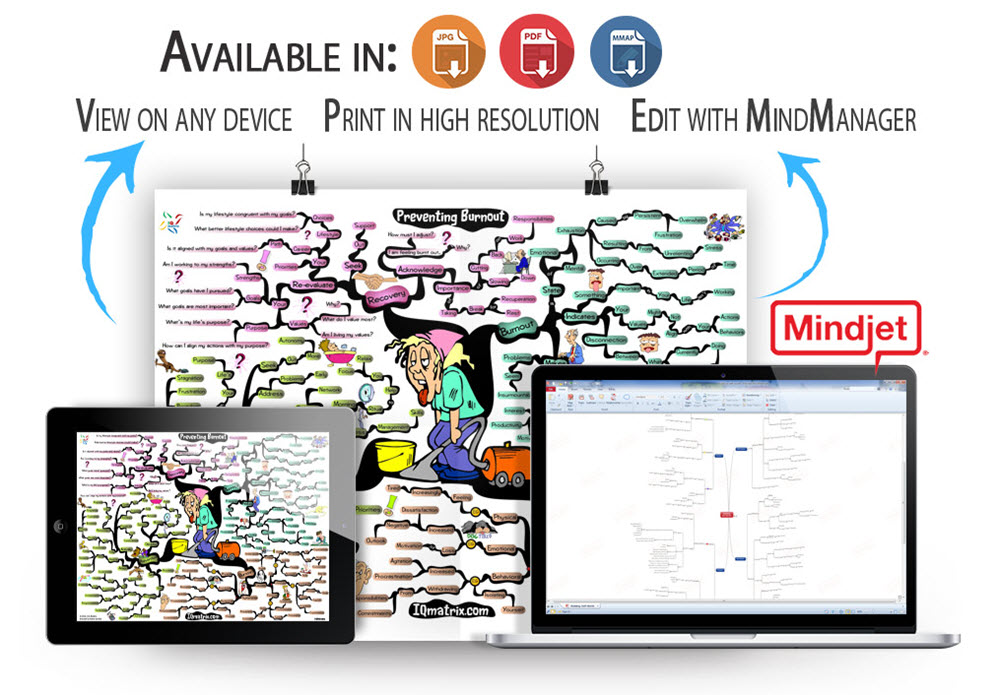
The Preventing Burnout IQ Matrix provides a visual framework for recognising burnout symptoms, understanding the factors contributing to exhaustion, preventing further depletion, recovering your energy, and re-evaluating the priorities shaping your life.
The accompanying full eBook expands every major branch of the map with deeper explanations, realistic examples, reflective questions, and practical recovery guidance.
Click here to visit the IQ Matrix Store
Sources and References
Access Over 90 Free Visual Tools and Resources
When you register to become an IQ Matrix Member, you gain access to eBooks, mind maps, IQ Doodles, and visual templates valued at over $500, absolutely FREE!