It’s not the hours you put in, but rather what you put into those hours. – Anthony Robbins
Taking Back Control Over Your Life
In today’s day and age, we can easily become overwhelmed with information, people, and tasks that sometimes tend to get the best of us. Without effective knowledge, strategies, and tools, it is easy to see how too many small things can lead to stress and discomfort. It is this feeling of overwhelm, of not feeling capable of being able to deal with many tasks or situations at one time, that leads to chronic stress and fatigue. However, rest assured there is a way that we can effectively take back control over our lives. The secret lies in learning simple yet effective time management skills that will get you thinking about the process of time in a unique and potentially unexpected way.
Let’s discuss the time management process and effective strategies for making the most use of your time. Let’s also take a look at techniques and skills that will allow you to gain more time throughout your day, while also breaking down the mindset of an effective and efficient time manager. And finally, let’s delve into common time wasters that could be eating up more time than you might expect.
Your Time Management Action Steps
Learning a new skill and a set of strategies involves a process that must be diligently followed and acted upon. At first undertaking, this process might feel uncomfortable and somewhat tedious. That is understandable, as anything new takes time and effort to practice and eventually absorb into our daily routine.
When it comes to time management the process is pretty straightforward, however, it may take a little patience and some effort at first before it eventually becomes ingrained into our psyche as a new habit.
Here are some suggestions to get you started along your journey towards becoming a better time manager:
Begin by Tracking Your Time
The only way to improve your time management skills is to learn from and understand your current time management habits. This process simply involves carrying around a notepad and jotting down what you are doing every 15 minutes.
After one week, you should have a thorough understanding of where you are spending your time and where you are wasting it. Do not move onto any other time management strategies until you successfully undertake this step. After one week, analyze your time logs and determine where you feel you could be more productive.
Set SMART Goals
Once you have a clear understanding of your time management habits, you are now ready to outline the bigger picture by setting and writing down smart goals.
S…pecific
Your goals must be very specific in terms of what you would like to accomplish.
M…easurable
Your goals must have a time measure, or in other words a date of when they will be accomplished.
A…chievable
Your goals must be achievable given the resources you have on hand.
R…ealistic
Your goals must be realistic given the time frame you have laid out to accomplish them.
T…imed
Your goals must be timed, meaning that they must be broken down into smaller short-term objectives that lead to medium and long-term goals. With an understanding of the bigger picture you are working towards, you will be better equipped to more effectively manage your time.
Follow Up with Plans of Action
Whenever goals are set, a plan of action must immediately follow. Create a quick write-up and general action plan of how you will go about achieving these goals.
Create Task Specific To Do Lists
Now take your plan of action and convert it into a master to-do list of all the things that you must do in order to achieve this bigger picture.
Prioritize Your Tasks Accordingly
Now that you have your master to-do list written out, the next step is to create a daily to-do list where you write down and specify six key important tasks that you will accomplish today. As a general rule of thumb, you should be spending your time on important rather than urgent tasks.
Many of us spend so much time during the day trying to put out fires. We deal with so many low priorities yet urgent tasks and activities that keep us busy and moving, and at the end of the day, we wonder how in the world we accomplished so little. Step out of this habit trap today and begin focusing on just the important tasks before they become urgent and potentially stress-inducing.
Chunk Down Your Tasks
By grouping your tasks into similar categories of activities you will become far more productive and time efficient. For instance, make all your telephone calls within one block hour, and respond to all your emails during only specific times of the day. You can also group stationary activities (when you are at your desk) together with other activities that don’t require you to move around your office. Once your chunk-time is over, simply move onto something else, without making any further telephone calls or writing up emails.
Schedule Blocks of Time to do Tasks
When setting tasks, be sure to specify how much time you will be spending on each of these activities. If you do not specify a time, you may become caught up in wasting time on activities that are simply taking up too much time.
Every task and activity must be set around a realistic and achievable time frame. Do whatever you can to accomplish this activity within the time frame you have set. And when time has elapsed, immediately move onto something else. Don’t allow perfection to sabotage your success.
Stick to the 80/20 Rule
The 80/20 Rule states that 80 percent of your efforts will bring about only 20 percent of the results. On the flip-side, 20 percent of your efforts will bring about 80 percent of your results. Knowing this, identify the highest value activities that will have the largest impact on your success at the end of the day, week, month and year. Focus on accomplishing these tasks and activities first, before moving onto the 80 percent of activities that will only bring about 20 percent of the result.
Balance Your Routine
Finally, establish a daily, weekly and monthly routine schedule that will keep you moving forward and focusing on your most important goals, tasks, and activities. Routines are excellent ways of forming new and empowering habits that will help you become an effective time manager. However, be sure that at all costs you keep your routine balanced personally and professionally.
6 Effective Time Management Strategies
When it comes to time management, there are some simple strategies that we can apply to our daily routine that will instantly make us more productive and efficient. Here are some suggestions to get you started:
Be Flexible with Your Time
Know and understand that the day will rarely go as you had planned. Emergencies will pop up and unexpected events may change your course and direction. You must be prepared for situations like these by creating a buffer system within your schedule. This buffer will allow you time throughout your day to deal with unexpected events and circumstances. However, be very careful not to become lost in these scenarios.
Set a time limit for yourself with respect to how much time you will spend putting out these fires, and then return back to your most important activities without a second thought. Just keep focusing on the bigger picture and keep moving forward by focusing on what’s most important.
Be Inflexible with Setting Time Limits
While it is important to be flexible with your schedule and routine, it is, however, critical that you are inflexible when it comes to setting time limits for specific tasks and activities.
Determine how much time you will spend on important activities and stick with them until time has elapsed (unless of course the activity or task is finished ahead of time). By being inflexible with setting your time, you will become more effective and efficient throughout your day.
Organize Yourself
Get yourself organized by starting with your thoughts. If you are finding that there is just too much information circulating around your mind at one time, then develop the habit of writing your thoughts out on paper and clearing your head of the clutter that is weighing you down. Once your plans, tasks and ideas are on paper, your head will be much clearer and more organized.
Organize Your Environment
Do you waste many precious minutes of your day simply looking for things? If you answered YES, then you know what you must do. Simply organize your files and folders in ways that will make things quick and easy to find at a moments notice.
Another area you should take a look at is your computer and email system. If you are spending too much time browsing through icons, folders, and files, trying to look for something that should be easy to find, then you might want to look at rearranging your computer folder system and email management process.
Remember, the initial process of organizing your environment is the easy part. It is the ongoing process of keeping it organized that may be difficult for the unprepared mind. As a simple tip, just follow the rule of putting things away where you found them or storing things immediately when you receive them. The moment you leave one piece of paper lying around where it doesn’t belong is the moment when you start to lose control.
Get Organized by Setting Reminders
Two simple ways to remind yourself about task and activities is to use sticky notes (post-its) or to carry around a voice recorder. Both are proven ways of capturing quick ideas that you can later transfer into your daily to-do list.
Identify Bad Habits
As you are periodically organizing yourself and your environment, keep a watchful eye on time-sapping habits that may sabotage your progress and success. Identify them and work on strategies to rid yourself of these nasty habits once and for all.

How to Gain More Time Throughout Your Day
It is said that no matter how busy we may appear to be, that we can all gain time throughout our day by either improving certain skill-sets or by applying simple techniques and strategies that will make us more efficient and proficient when it comes to effectively managing our time.
Here are some suggestions that will get you thinking in the right direction:
9 Critical Time Management Skills
The following are a set of skills we must all work on improving throughout our days in order to become a far more effective and efficient time manager.
Computer Literacy
Improve your computer literacy by learning how to use certain pieces of software that will cut down the time, energy and effort it takes you to undertake specific tasks and activities. Even learning simple program shortcuts can dramatically cut down the time it takes you to write a report or prepare a presentation. Look online for beginner tutorials or find a workshop or course within your area.
Creative Capacity
Learning to be creative will allow you to develop unique ideas that will help you save time and become more productive throughout your day.
Critical Thinking and Problem Solving Skills
Having the ability to think critically about situations will allow you to spend less time on the process of thinking and more time on doing and implementing.
Delegating Ability
Learning how to delegate work efficiently and effectively will save you an ample amount of time. Having another pair of hands undertaking the tasks and activities that you would normally spend time on, clearly frees you up to focus on other matters. The opportunity cost of paying someone to do something could well be the catalyst that dramatically boosts your productivity.
Negotiation Skills
Sometimes because we cannot agree with others about how things should be, it naturally draws time away from more important matters. By learning how to negotiate more effectively will help you reach a satisfactory agreement much faster, which will, therefore, allow you time to focus on other matters.
Emotional Intelligence
Whenever our emotions tend to get the better of us, we lose time and become very unproductive in the process. Emotional Intelligence involves the process of taking proactive control of our emotions and projecting them in ways that will boost our productivity and performance.
Multitasking Ability
Spend time grouping tasks and activities together, and work on developing and improving your multitasking skills. As a cautionary note, on very important tasks that require a lot of thought and attention, it is suggested that you do not multi-task because often multi-tasking can cost you more time than you actually think you are saving.
Decision-Making Ability
The faster you are able to reach a definitive decision, the more time you will save.
Speed of Reading
The faster you learn to read and absorb information the more information you will cover in less time. It, therefore, helps to take a course on accelerated reading.
6 Techniques to Help You Gain More Time
The following is a list of just a few techniques you can utilize on a daily basis to help you become a more efficient and effective time manager.
Utilize Affirmations
Simple affirmations such as “I am becoming more efficient and proficient with my time each and every day” will keep you on the right track towards your time management goals.
Take Regular Breaks
Your body and mind need regular breaks throughout the day. On the surface working five hours straight might seem as though it will result in more productivity. However, we must understand that spending long hours of time on a certain activity fatigues the brain, stumps creativity and nullifies a person’s problem-solving ability. By taking regular breaks you refresh the mind, clarify the thought processes, and improve the creativity and flow of information.
Learn to Say “No”
By simply saying NO to people’s requests for help and assistance, you will avoid committing yourself to something that will eat up your time and make you feel guilty in the process.
Create Systems and Processes
Everything that you do can be created into an effective system or process that could dramatically shorten the time the task or activity normally takes to perform. Commit yourself towards thinking in systems by asking yourself.
How can I simplify this activity into a system or process that will save me time, energy, money and effort?
Eliminate Unnecessary Obligations and Tasks
Sometimes we simply do not have time because we spend too much time on unnecessary and low-value tasks, activities or obligations that are tying us down. Commit yourself today and make a decision to eliminate these obligations, tasks, and activities once and for all.
Commit to Constant Improvement
Everything can and should always be improved upon each day. No matter what kind of task, activity or process you are undertaking, everything can be improved if you continuously feed your mind with questions that will expand your thinking and awareness about the way you are going about your daily obligations. Just learn to ask yourself the right questions and you will be rewarded with answers that will save you both time and money.

The Mindset of an Outstanding Time Manager
When it comes to effectively managing your time, techniques and strategies will only take you part of the way. One must also learn to cultivate a mindset that will naturally compliment these strategies in ways that expand one’s awareness and understanding of time. Here is a closer look at the time efficiency mindset:
Critical Time Efficiency Questions
The first step towards a time efficiency mindset begins with asking yourself the right kinds of questions to stimulate thoughts about how you are utilizing your time.
Throughout your day ask yourself the following three questions. These questions will keep you focused and centered on what is most important:
What is the best use of my time right now?
What is the future impact of this activity?
Am I the best person to perform this job?
Become an Optimistic Realist
Becoming an optimistic realist means being optimistic about your ability to get things done in the most effective and efficient manner. Moreover, it also means that you understand possible obstacles, challenges, and problems that may arise, and can, therefore, respond to them accordingly.
Become Proactive Rather than Reactive
Being proactive means that you are physically and emotionally taking charge of the tasks and activities that you are responsible for on a daily basis. Despite unexpected surprises and challenges that may arise, you remain calm and under control, thinking proactively in ways that will bring about solutions and move you forward in a productive manner.
If on the other hand you are always physically and emotionally reacting to events and circumstances, you will suffer the consequences by experiencing the emotions of fear, overwhelm and stress.
Apply Focused Concentration
To become an efficient time manager, you must display focused effort and concentration on nothing other than the activity you are currently undertaking. Remove absolutely all distractions and zero in on just the task at hand.
Don’t Seek Perfection
If you have a habit of seeking to perfect everything you do, then you have very little chance of mastering your time. Realize that perfection is simply an opinion. What you consider as being perfect may not be how others look at the situation. On the other hand, your imperfect actions may indeed be more than satisfactory for others. Ask yourself,
Will an extra 10 minutes spent on this activity really make a significant difference to the end result?
If the answer is NO, then you know what to do.
Show Commitment and Discipline towards Completing Your Tasks
When you set a task or activity for yourself, commit yourself to applying diligent consistent effort to do whatever it takes to get the job done within the time frame you specified. Only with this type of mentality will you develop the necessary habit of self-discipline that will evolve you into an efficient time manager.
Show an Enthusiastic Attitude
Throughout your day no matter what sudden surprises or problems pop up, keep a smile on your face along with a bubbly attitude. Simply see everything as a challenge that you will work through in a progressive and proactive manner towards the bigger objectives and goals. An enthusiastic attitude will also keep your energies high when things seem to be falling apart around you.
6 Common Time Wasting Activities to Avoid
As wonderful as it is to cultivate the habits of efficient and effective time management, it is equally important to grasp an understanding of where we might be wasting our time on activities that simply provide us with little value or reward. Here are just a few time-wasting activities that may be robbing you of more than just your time:
Avoid the Habits of Procrastination and Laziness
Procrastination is the habit of avoiding a certain activity and making up every excuse in the world that helps you feel better about your actions.
Be very careful with this one, because procrastination sometimes sneaks up on us when we least expect it. Even simple things like planning too much, taking an extended lunch-break, having too many breaks, etc, all are key signals of procrastination. Keep an eye out on these signals and work on cultivating the time efficiency mindset discussed above.
Avoid the Trap of Waiting
Whether you are waiting in line at the grocery store, or for your appointment to arrive, it all means one thing: you are simply wasting time when you could be doing something that will bring you a greater sense of fulfillment and the results you want most at the end of the day. However, sometimes these kinds of things are simply unavoidable. In that instance, prepare yourself in advance by taking some reading materials or making important telephone calls.
As long as every minute of your working day you are doing something that keeps you moving forward and gets you the end result you are after, then you are on the right path towards mastering your time.
Avoid Constant Disruptions
Disruptions will make you lose focus, concentration and will interrupt your creative thinking process.
Studies have shown that it can take anywhere from 5 to 15 minutes after a disruption has occurred for a person to gain back the momentum they had before the disruption. To avoid these occurrences, simply inform others that you will not be available during a specific period of time and that you don’t want to be disturbed unless it is a personal emergency.
Avoid the Habit of Just Staying Busy
Keeping busy is a form of procrastination. There are just so many things that we can do throughout our day that have very little impact on our goals and objectives.
Go back to the 80/20 rule and commit yourself to working on the 20 percent of activities and tasks that will help you accomplish 80 percent of your goals and objectives. Only once these tasks have been completed should you move on to the 80%.
Avoid the Technology Trap
Technology is great if used in a way that will benefit your long-term goals and objectives. On the other hand, if technology is abused it can sabotage your time and lock you away into the habit of ongoing procrastination. Too much internet surfing, email responding, watching television, talking over the telephone, or listening endlessly to the radio will sabotage your time probably more than anything else on this list.
Avoid these three Time Robbing Emotions
The three emotions of fear, stress and overwhelm are all an outcropping of one’s inability to proactively manage their time. If you are able to use and apply all the techniques and strategies discussed in this post, then these emotions will no longer affect your productivity throughout the day.

Concluding Thoughts
Applying the habits of effective time management takes a little diligent effort, however, if consistently practiced and implemented throughout your day, it will lead to a greater sense of satisfaction and freedom that you might not have experienced in a very long time. By actually taking the time to cultivate these strategies, techniques, and mindset, you will likely find that you will not only gain more time, but you might also discover that you also gain back your life.
Time to Assimilate these Concepts

Did you gain value from this article? Is it important that you know and understand this topic? Would you like to optimize how you think about this topic? Would you like a method for applying these ideas to your life?
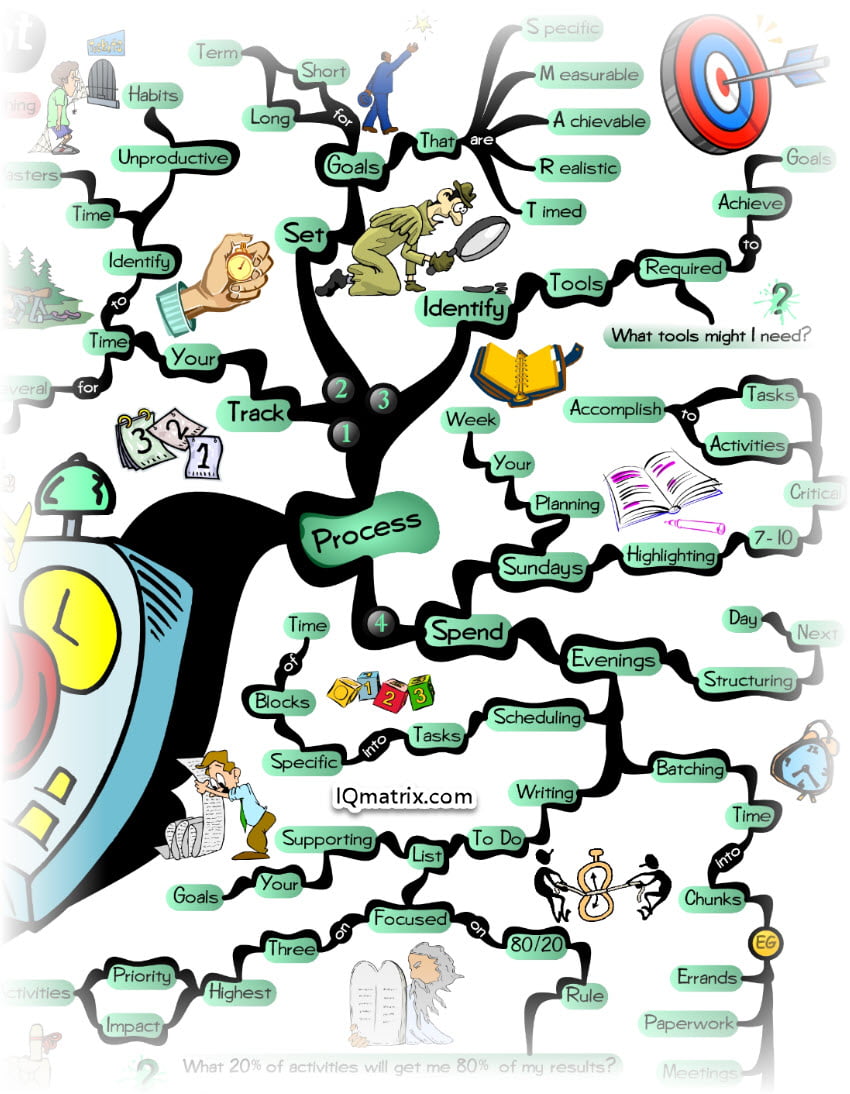
If you answered yes to any of these questions, then I’m confident you will gain tremendous value from using the accompanying IQ Matrix for coaching or self-coaching purposes. This mind map provides you with a quick visual overview of the article you just read. The branches, interlinking ideas, and images model how the brain thinks and processes information. It’s kind of like implanting a thought into your brain – an upgrade of sorts that optimizes how you think about these concepts and ideas. 🙂
Recommended IQ Matrix Bundles


If you’re intrigued by the idea of using mind maps for self-improvement then I would like to invite you to become an IQ Matrix Member.
If you’re new to mind mapping or just want to check things out, then register for the Free 12 Month Membership Program. There you will gain access to over 90 mind maps, visual tools, and resources valued at over $500.
If, on the other hand, you want access to an ever-growing library of 100s of visual tools and resources, then check out our Premium Membership Packages. These packages provide you with the ultimate visual reference library for all your personal development needs.
Gain More Knowledge…
Here are some additional links and resources that will help you learn more about this topic:
- 15 Time Boxing Strategies to Get Things Done @ Litemind
- How to Do Less but Achieve More @ Life Optimizer
- 20 Tips for Batching to Save Time and Cut Stress @ Scott H Young
- 12 Hours to Better Time Management @ Lifehack
- 33 Rules to Boost Your Productivity @ Steve Pavlina
- 25 Painless Ways to Free Up an Hour a Day for Your Goals @ Zen Habits
- 7 Simple Time Management Rules @ Dumb Little Man